It's like an orgasm in my mouth and everyone's invited. Oh yes.
This bad boy is a midwestern-only specialty from St. Joseph, Missouri: Cherry Mash, a regional discovery whose greatness outranks both Zero bars and Ruby Red Squirt. Like all good early 20th century packaged foods (the label proudly boasts "Since 1918"), it still retains its cute cartoon mascot: the Chase Cop.
Inside the wrapper hides this chocolatey ball of nugget. It's misshapen, bumpy, and resembles a small turd, the least attractive candy I've seen in an age where candy bars come with smooth outer chocolate shells (sometimes with that wisp fused to the top where the machine dripped a final line of melted chocolate back on to the bar. Funny how what started as a natural twist of the baker's spatula can be reproduced so precisely by a machine). This effect causes the candy to resemble something made at home with baking chocolate and a bag of nuts rather than in a factory using the artificial flavors listed on the wrapper.
I can't believe how good this candy is. The inside consists of a thick cherry fondant, a mix of maraschino cherries and that cherry flavoring one finds in popsicles and Life Savers. I love cherry cordials, but this - the inside of this compresses all the flavor of a cherry cordial into a marshmallowy ball of sugar goodness. It's richer than a regular nougat-based candy (think Snickers or Milky Way), which it can get away with due to its small size (I finished mine in four and a half bites); a full bar of this would yield a sugar overload and cost as much as a small cake. I paid $1.29 for mine at an outmoded convenience store/car wash, a haven for these kinds of regional treats.
Those driving (or residing) in the Midwest would be wise to check out Cherry Mash (the Chase website offers a location map). Others can try making Cherry Mash at home - your hand-rolled mashes shouldn't look much different than the ones made in the factory.
Showing posts with label This post has lots of photos in it. Show all posts
Friday, July 18, 2014
Sunday, July 28, 2013
Canadian Observations
Top 5 Distinctly Canadian Experiences From My Trip to Ottawa:
5. Took pictures of takeout chains featured in the movie "Scott Pilgrim vs. The World."
4. Played cribbage for a toonee.
3. Heard The Tragically Hip on the radio - twice.
2. Saw Gord Downie dance.
1. Ate poutine. Delicious, delicious poutine.
BONUS: Ordered a double-double from Tim Horton's.I drove to Ottawa to see the Tragically Hip in concert and to visit my old co-worker from Japan. Despite the Tragically Hip's being absolutely huge in Canada, with multiple hits, lots of radio play, and a cultural ubiquity yearned for by bands everywhere, no one in America seems to know who the hell they are. Check out their stuff here.
In a roadside Tim Horton's parking lot I saw this large truck proudly brandishing a Confederate flag. This provoked a slight mental breakdown as I attempted to figure out why citizens of another country were supporting the Confederate South.
Barely visible on the dash is a model of the General Lee from Dukes of Hazard, which explains pretty well how fans of the show, or of Southern outdoor culture in general, could use the Confederate flag not to represent issues of white supremacy, states' rights, or hometown pride, but to fit in with social fandom.
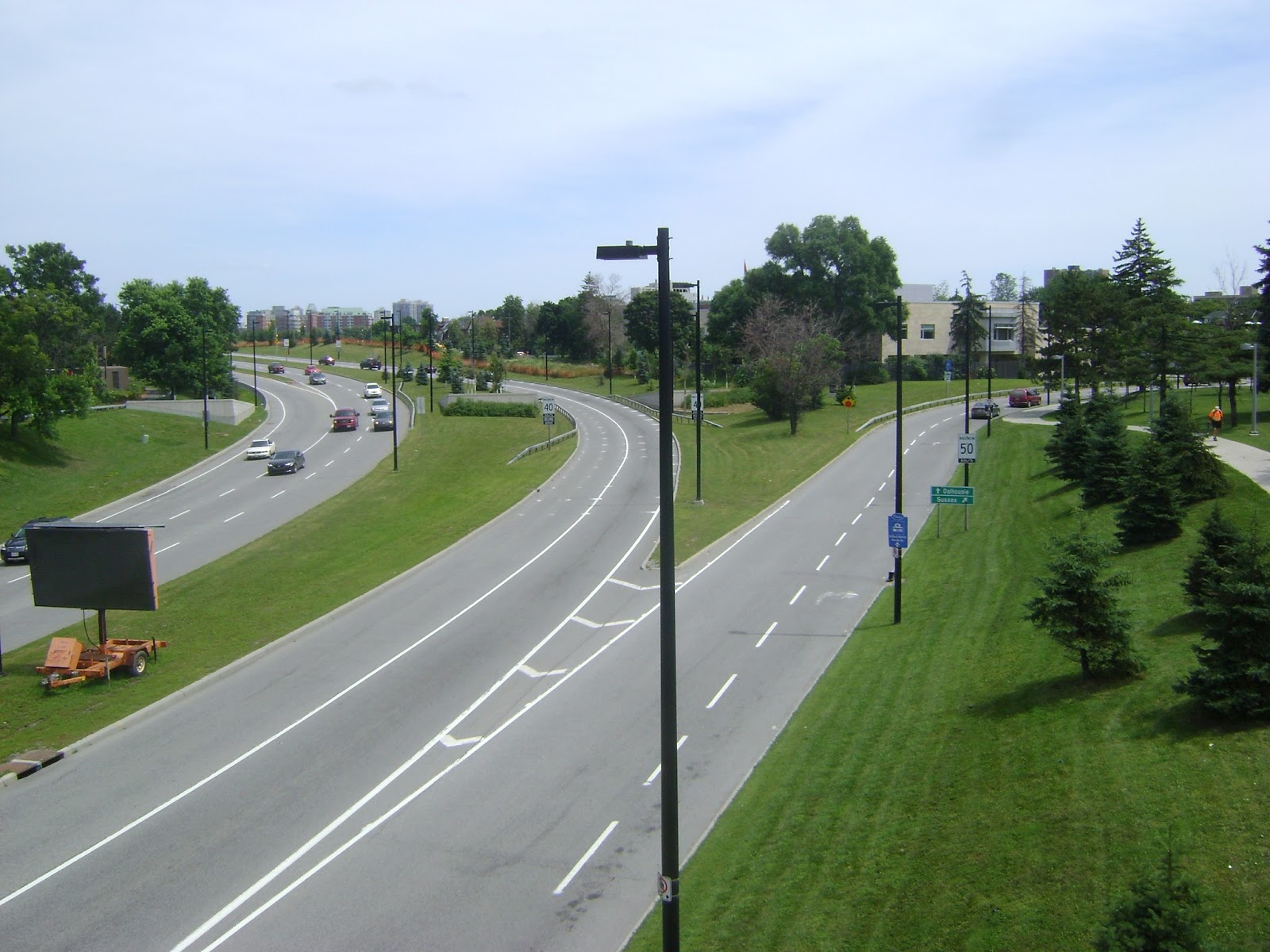
Parkways like this one run around the city of Ottawa and through its center. There was never a lot of traffic anywhere, and it seemed like most people lived in the city limits, rather than in suburbs. I also saw a lot of people of all ages walking, riding bikes, and taking the bus. Compared to places like Boston, New York, and Washington, most of the area around Ottawa and Gatineau (on the other side of the river) is empty space, with a large national park about twenty minutes from the city.
Bell telephone booths with swinging plastic doors, two of the many I saw on the trip. I'm not sure if pay phones get more action in Canada, if they're unused and waiting to be removed, or if public phones receive some sort of government subsidy.
Pizza and poutine place inviting viewers to combo it up.
Rideau Hall, and home of the governor general of Canada. The governor general (a job that doesn't exist in the states) acts as the queen's representative in Canada by signing bills and convening with the prime minister. (Canadian readers: feel free to correct my oversimplified and possibly erroneous explanation in the comments section.) The hall is free and open to the public, and the tour guides provide a pretty good crash course in Canadian history.
One thing that struck me overwhelmingly about both Rideau Hall and the museums I visited was that, while the museums in America's capital cater to a wider audience of domestic and international visitors, Ottawa's tourist attractions warmly celebrated Canadian pride. Hanging flags with the providence names abounded, and signs reminded visitors that this was your museum, to celebrate your country. Bilingual signs in English and French formed the impression that all Canadians were welcome. Ottawa's tourism website even declares that the capital region is "Canadian, just like you."
Far from making me feel unwelcome as a foreign visitor, the distinctly Canadian warmth seemed sprung from necessity rather than xenophobia: the city, unlike DC, was simply not expecting many foreign visitors, and had focused its efforts of welcoming domestic ones. Rather than viewing the sentiment as quaint, I found their nationalism inspiring, and unlike anything I've seen in America in some time.
To Sum Up: Ottawa is awesome and you should go there. You should also listen to the Tragically Hip.
Tuesday, August 16, 2011
Karate Church!
When businesses expand or go under, their buildings are sold to other businesses who set up where their predecessors once ran, just as when one family leaves a home, another family moves in. But what happens when an old downtown church moves to a new location?
There's hardly a large number of fledgeling New England churches looking to set up shop in a cheap location, nor can one just demolish a house of God to make room for a new CVS pharmacy. The solution, then, is to rent out the space to a business who can use it, with curious results.
Master An's Tae Kawn Do Academy is located in Bedford, New Hampshire, just past the Everett Turnpike on the toll-skipping route between Manchester and Nashua. I stopped there on a Sunday to take some pictures.
As you can see, the door has been covered with a painting of traditional Eastern dragons, and the tall side windows painted with Chinese characters. I sadly did not get a chance to go inside and see how they had remodeled the main hall (if at all).
Afterward, I remembered that New Testament story about Jesus going into the temple and driving away all the peddlers and shopkeepers who were selling their wares there. If doing business in the Lord's house is wrong, then is it still wrong if the congregation has moved to a new location? When does a church stop being a church? (Think about this one for a minute.) If the congregation moves for a few years and then comes back, is the church still sacred ground while the congregation is gone? Is there a ceremony that happens after a church is shut down to desanctify the building? Or will a church always be a church long after the congregation has moved on to a large suburban location with a two-acre parking lot and a brand-new LED sign?
Other Uses for Old Churches I'd Like to See:
There's hardly a large number of fledgeling New England churches looking to set up shop in a cheap location, nor can one just demolish a house of God to make room for a new CVS pharmacy. The solution, then, is to rent out the space to a business who can use it, with curious results.
Master An's Tae Kawn Do Academy is located in Bedford, New Hampshire, just past the Everett Turnpike on the toll-skipping route between Manchester and Nashua. I stopped there on a Sunday to take some pictures.
As you can see, the door has been covered with a painting of traditional Eastern dragons, and the tall side windows painted with Chinese characters. I sadly did not get a chance to go inside and see how they had remodeled the main hall (if at all).
Afterward, I remembered that New Testament story about Jesus going into the temple and driving away all the peddlers and shopkeepers who were selling their wares there. If doing business in the Lord's house is wrong, then is it still wrong if the congregation has moved to a new location? When does a church stop being a church? (Think about this one for a minute.) If the congregation moves for a few years and then comes back, is the church still sacred ground while the congregation is gone? Is there a ceremony that happens after a church is shut down to desanctify the building? Or will a church always be a church long after the congregation has moved on to a large suburban location with a two-acre parking lot and a brand-new LED sign?
Other Uses for Old Churches I'd Like to See:
- Movie Theater
- Glow-stick Rave Venue
- Family Fun Center
- New location for the Bradford Junction
- Water Park
- Go-kart Amusement Area
- Really big Goodwill/Salvation Army
- Used Car Lot
- Studio Apartment
- Miniature Golf Course in which the player needs to hit the ball through the front door and out the back to win a free game
- CVS Pharmacy
Thursday, January 20, 2011
My First Aomori

Japan’s new Bullet Train (Shinkansen) service to the northern city of Aomori opened on December 4th. To alert the public to this momentous event, the walls of every JR Railway station were plastered with advertisements featuring well-groomed railway employees standing stiffly at attention and smiling tourists happily exploring the sights of Aomori prefecture. Their TV commercial (EDIT: now removed from Youtube....) sums it up pretty well.
I find this campaign hilarious for two reasons. The first is the name: My First Aomori. It sounds pretty normal at first, but the more you hear it, the more ridiculous it sounds. My First Aomori. Not “My First Trip to Aomori” or “My First Aomori Experience,” but just “My First Aomori.” It’s like there’s a subject missing. Are we to assume that the consumer is taking control of Aomori prefecture for the first time? Or does Aomori refer to some type of consumer goods that can be purchased and kept as a memento?
The second reason is the truth that, despite JR’s attempts to convince the public of the contrary, there’s not a whole lot to do in Aomori. There’s a little castle there, a handful of museums in the capital city, and some natural scenery in the rural northeast area where the Shinkansen doesn’t go. And in December, when Aomori is blanketed by a foot of snow, there’s even less to do. Despite northern Japan’s tendency towards inclement weather, I didn’t see a trace of snow in any of the posters or TV commercials. I like to think that some foolhardy tourists traveled all the way to Aomori only to be surprised that it wasn’t some sort of magical summer wonderland where the sun always shone and the grass was always green.
The one part that JR got right was the apples. Aomori is known for its apples, which are actually really good. I didn’t, however, think they were good enough to merit an entire trip to Aomori just to eat them, nor were they good enough to feature as prominently as they do in the shop windows, souvenir snack treats, character advertising, and yes, even the mailboxes.
Everything in Aomori was either about apples or the Shinkansen, which shouted its existence to the public on enormous banners hung from buildings and signs posted along the streets on Aomori city. The whole thing reeked of an elaborate attempt to make this otherwise ordinary section of Japan’s northeast region stand out. The Japanese government spent a lot of public works money on the new Shinkansen service, and I sensed a desperate need to get some of that investment back. Though, in Japan, construction is a way of life, as even the most rural roads are constantly paved with fresh concrete, its rivers dammed, its mountainside roads shielded by high retaining walls, and its tiny islands strung together with expensive new bridges. Perhaps the new bullet train is just another way for a nation heavily invested in the construction industry to spend its money. Or maybe Japan has a deep-seated need to prove to the rest of the world that it’s powerful enough to thrust its mighty Shinkansen as deep into the unspoiled countryside as physically possible.

Because, really, what does this remind you of?
Friday, January 7, 2011
A Picture Essay of My Tohoku Trip
ASPEX app.gre 23 a/45.html=READ ERROR 459B tohokuforupload.zip SORT 3/2 <> +ESD.html
For this New Years vacation, I decided to take one last great trip in Japan to the Tohoku (northeast) region, made possible through a JR bargain rail ticket but complicated by rural Japan’s infrequent local train schedules. Why would I embark on a trip to a bitingly cold part of Japan with little to offer tourists on a schedule that had me riding the trains almost as often as I was seeing the sights? I hadn’t been there before, I needed to think things over, and I wanted to see snow.

My first stop was Sendai, the largest city in the Tohoku region and a place devoid of museums or historical sights. A friend recommended I visit the Sendai Mediateque, an architecturally interesting building containing a few art galleries (closed for New Years), a large art library (all in Japanese) and an open exhibit of snow falling against a shadowed background. Along the street outside was the (apparently) famous Sendai Christmas illumination, which, though beautiful, would have been better with snow.

This is the Japanese ryokan hostel where I stayed in Sendai, complete with tatami floors, traditional Japanese breakfast, and flat-screen television.

This is Aomori prefecture at the northern tip of Japan, where I saw my first real snowfall. There was something remarkably peaceful about it. Last winter Yamanashi only received a few light dustings of snow, and I’d forgotten how the snow can make the landscape come alive by hiding the brown dullness of late autumn. Here you can see the Bay Bridge, an interesting landmark that connects two small pieces of land that could easily be crossed by driving around the block.

The Tyrell Corporation has also set up a branch office in Aomori city.

This is the Aomori Contemporary Art Center, an open art facility with a gallery and studios for working artists designed by Tadao Ando. The larger, half-circle portion on the left contains a gallery (free admission) filled with entrants for a recent print competition. You may remember Ando as the architect behind the Naoshima island museums I visited back in July, and I mention him again because his work has given me a new appreciation for architecture. This building, set against the snowy landscape of a northern forest, reminded me even more of a certain building from my college years.

This is the coolest izakiya I’ve ever seen. The shower scene cinches it.

The port city of Hakodate, on the northern island of Hokkaido, was one of the first Japanese cities open to Western trade, and was largely spared during World War II. As a result, many of the 19th century European-style buildings and churches still remain, including this one, the old Public Hall at the top of the hill.

For 10,000 yen, you can buy monstrous crab legs bigger than my hand. And I have big hands.

My travel pamphlet proudly boasted that the view from Mt. Hakodate at night is the greatest in the entire world. I’m hesitant to agree with such a grandiose statement, but it is pretty nice.

Hirosaki Castle in Aomori prefecture. Like most castles in Japan, the original burned down long ago, and this corner fortification is all that remains.

One of the temples of Chuson-ji in Iwate prefecture. The temple grounds were unbelievably peaceful in the freshly fallen snow, with a minimum of distraction from tourists.

Boat tour through the majestic Geibikei Gorge, also in Iwate. This is one of the most beautiful places I’ve visited in Japan, and, astoundingly, features a rock profile eerily similar to New Hampshire’s dearly departed Old Man of the Mountain. Our tour was lead by an old man in an umbrella hat who sang us a song on the ride back.

More Geibikei Gorge.

Matsushima, my final stop, and a site the tourist information board proudly labeled “Matsushima 3 Best View!” Matsushima is a group of about two hundred-sixty tiny islands rising out of the sea near Sendai, and was a fitting place for my New Years contemplations. It’s time to return to the States to face the future with courage in the new year. No more confused wandering or obsessive deliberation. As long as you keep moving in one direction, you’ll always get somewhere.
For this New Years vacation, I decided to take one last great trip in Japan to the Tohoku (northeast) region, made possible through a JR bargain rail ticket but complicated by rural Japan’s infrequent local train schedules. Why would I embark on a trip to a bitingly cold part of Japan with little to offer tourists on a schedule that had me riding the trains almost as often as I was seeing the sights? I hadn’t been there before, I needed to think things over, and I wanted to see snow.
My first stop was Sendai, the largest city in the Tohoku region and a place devoid of museums or historical sights. A friend recommended I visit the Sendai Mediateque, an architecturally interesting building containing a few art galleries (closed for New Years), a large art library (all in Japanese) and an open exhibit of snow falling against a shadowed background. Along the street outside was the (apparently) famous Sendai Christmas illumination, which, though beautiful, would have been better with snow.
This is the Japanese ryokan hostel where I stayed in Sendai, complete with tatami floors, traditional Japanese breakfast, and flat-screen television.
This is Aomori prefecture at the northern tip of Japan, where I saw my first real snowfall. There was something remarkably peaceful about it. Last winter Yamanashi only received a few light dustings of snow, and I’d forgotten how the snow can make the landscape come alive by hiding the brown dullness of late autumn. Here you can see the Bay Bridge, an interesting landmark that connects two small pieces of land that could easily be crossed by driving around the block.
The Tyrell Corporation has also set up a branch office in Aomori city.
This is the Aomori Contemporary Art Center, an open art facility with a gallery and studios for working artists designed by Tadao Ando. The larger, half-circle portion on the left contains a gallery (free admission) filled with entrants for a recent print competition. You may remember Ando as the architect behind the Naoshima island museums I visited back in July, and I mention him again because his work has given me a new appreciation for architecture. This building, set against the snowy landscape of a northern forest, reminded me even more of a certain building from my college years.
This is the coolest izakiya I’ve ever seen. The shower scene cinches it.
The port city of Hakodate, on the northern island of Hokkaido, was one of the first Japanese cities open to Western trade, and was largely spared during World War II. As a result, many of the 19th century European-style buildings and churches still remain, including this one, the old Public Hall at the top of the hill.
For 10,000 yen, you can buy monstrous crab legs bigger than my hand. And I have big hands.
My travel pamphlet proudly boasted that the view from Mt. Hakodate at night is the greatest in the entire world. I’m hesitant to agree with such a grandiose statement, but it is pretty nice.
Hirosaki Castle in Aomori prefecture. Like most castles in Japan, the original burned down long ago, and this corner fortification is all that remains.
One of the temples of Chuson-ji in Iwate prefecture. The temple grounds were unbelievably peaceful in the freshly fallen snow, with a minimum of distraction from tourists.
Boat tour through the majestic Geibikei Gorge, also in Iwate. This is one of the most beautiful places I’ve visited in Japan, and, astoundingly, features a rock profile eerily similar to New Hampshire’s dearly departed Old Man of the Mountain. Our tour was lead by an old man in an umbrella hat who sang us a song on the ride back.
More Geibikei Gorge.
Matsushima, my final stop, and a site the tourist information board proudly labeled “Matsushima 3 Best View!” Matsushima is a group of about two hundred-sixty tiny islands rising out of the sea near Sendai, and was a fitting place for my New Years contemplations. It’s time to return to the States to face the future with courage in the new year. No more confused wandering or obsessive deliberation. As long as you keep moving in one direction, you’ll always get somewhere.
Wednesday, October 20, 2010
My Neighborhood
This is the unnamed street I live on, part of a faded though very functional community called Takara (treasure in Japanese) a ten-minute walk from Kofu train station. Like most of the communities radiating around the station area, the buildings are older, the inhabitants aging, and the shop wares dusty and out of style. I like it here a lot.
This is the building where I live (middle floor, far left). It's a lot brighter than any other building on the street. The tiling is pretty cool, as well as the circular stairs outside, which offer a nice view of the surrounding street, the hospital towering above, and the mountains beyond.
This is the stand where I buy my vegetables and eggs. The outside is heaped with great boxes of onions and potatoes that go bad quickly, plus fruit of dubious quality. Most of the produce inside is better and keeps for longer, sitting alongside old display cases stocked with canned tuna and pineapple. There is usually a woman of indeterminate age in the living room behind the store who comes out when she hears the door open. Sometimes we talk in Japanese. Other times an old man rings me up, and he always counts what I've bought with an abacus. It's pretty awesome.
The building on the right is a bakery down the street. They specialize in rolls stuffed with different kinds of filling, though I also buy bread from there sometimes. Like the vegetable stand, I have no idea how they stay in business because there's never anyone inside. I always buy from the day-old rack because day-old bread in Japan is the same as fresh bread in America. If I go on Saturday evenings they usually give me an extra roll or two for free.
To the left is a small bar with wood-paneled walls. I've never been inside because it's always either empty or filled with drunken middle-aged men. In the interest of curiosity I may give it a try before I leave.
This is the inside of the laundromat (koin randoree) on the next block. It has a musty smell and is usually filled with old coffee cans. I don't need to use it since I have a washing machine, but if I was ever in a pinch and needed a dryer, it's reassuring to know that it's here.
This is the small medical clinic across from my apartment. I'm not sure what kind of clinic it is but I know they must have patients sometimes because the front room has a bed surrounded by a curtain and several machines. One of the nurses who works there is kind of hot. I saw her making the bed after I took this picture.
To the right of the clinic is a barbershop that appears to be out of business. The sign and barber pole are still there, but no one ever answered when I knocked looking for a quick haircut. Instead, someone always parks a moped (not shown) on the front step.
This is the nicest house on my street. A young family with kids lives here, and I assume that an older concrete building was torn down to build this one before I moved in. To the left of this house there used to be a really cool old building that was also torn down last spring to make room for a less entertaining parking lot.
There are a lot of vending machines (hapi dorinku shoppu) here. The second one from the right has Mountain Dew.
In the other direction sits this boarded-up machine shop. I want very badly to sneak inside but cannot discern any simple methods of entry. There are some other shops like this one a few blocks away still in business, but everything there is really expensive and there's never anyone inside.
This is a really, really small bar up the street from the electronics shop. Only about four people could fit at the counter inside, and I think it's the kind of place where everyone who drinks there knows the owner. I think it'd be pretty cool if your friend down the street owned a bar that you could drink at whenever you wanted. You also wouldn't have to worry about driving home.
Like most houses in the older city, this one has about a million plants outside. It's pretty cool to walk down the gray concrete streets and have all this nature around you, even if it is in pots and on people's balconies. One day I was walking by and the guy who lives here had set up a display of alpine plants for sale. The plants all resembled ferns and were growing out of shelves of rock. The guy said they came from Nagano and explained in Japanese how to take care of them. I bought one for a thousand yen and put it on my balcony, where it flowers whenever there's a rainstorm.
This is just a picture of the other side of the street. In the distance you can see a small machine shop that always has a lot of scrap metal stacked out front, and past that is the corner where we put our recycling once a month (I always forget, though). The tall building on the corner looks like it might be really fancy inside. Most afternoons and some nights there's flute music coming from one of the apartments, which I think is someone actually practicing rather than a recording. The music gives the normally-quiet street an upbeat, exciting feeling. It is a sign that people live there.
Subscribe to:
Posts (Atom)