Showing posts with label Travel Adventures. Show all posts

Friday, January 22, 2016

In Which Our Hero Discusses Japanese Monetary Customs With a Junior Teller at Wells Fargo

Japanese 2000 yen notes (worth about $20 US), featuring the Shureimon gate (front) and Lady Murasaki Shikibu with a scene from The Tale of Genji (back).

INT. BANK LOBBY – DAY

IAN is buying Japanese yen from a young TELLER behind the counter of a bank lobby whose ceiling is exorbitantly high. The TELLER counts out the notes, which IAN then considers.

IAN: Do you mind if I trade in some of these two-thousand notes for a few five-thousands? Japanese people don't really use them, so they'd peg me as a tourist.

TELLER (surprised): Uh, I didn't know that. (checks computer) Sorry, we don't have any other yen here.

IAN: That's fine. It'll just be like I started using two-dollar bills everywhere.

TELLER (oblivious): Oh. (Pause, after which he begins to speak from a clearly rehearsed script.) Now, will you be using your debit card in Japan?

IAN (tilting his head in the Japanese manner of not wanting to correct someone): Not this time—Japanese businesses don't really take cards. They're still a cash society.

TELLER (wide-eyed): Wow, I didn't know that. I take it you've been to Japan before?

IAN: Yeah, a little bit.

---------------------------------------------------------------------------------------------------------------------------------------------------

Time to take a trip—my first time back in Japan in almost five years. Feels good to be doing something exciting again, to be going to a place where daily life will be just a little bit more challenging.  That's the kind of thing that makes you sharper.

Lots of changes coming for 2016. I finished a novel last year, finished grad school, and started doing more things that matter. Blogging also still matters—putting things out there in a form more substantial than a Facebook post or tweet keeps me sharp, and keeps the ideas flowing.

Been working on a better place to do that than Blogspot, though, which has become the blogging equivalent of AOL Instant Messenger (out of fashion, but technically still around). Stay tuned.

Wednesday, May 21, 2014

An Open Letter to the Marketing Executives at Super 8 Motels

Dear Sirs:

I'm writing to complain of your recent advertising partnership with Pizza Hut restaurants. Though your use of the red-roof Pizza Hut logo on your motel room keycards is itself mildly intrusive, more egregious is your obliviousness to said logo’s resembling a large arrow that would appear to designate the proper direction for inserting the keycard into the lock, when it reality the roof’s direction points toward the back of the keycard. The problem is worsened by the actual card insertion indicator, a small, dull triangle banished to a lower corner of the keycard where tired guests can easily miss it and (guided by the more massive and eye-catching Pizza Hut logo) insert their cards in the wrong direction. The likelihood of this mistake is such that during a recent stay, even the senior motel desk clerk inserted our card incorrectly and determined our door's lock to be low on batteries.

I recommend that you either A) Switch the direction of the Pizza Hut logo so that it matches the direction in which the keycard is inserted, or B) Make the insert directional arrow larger and the Pizza Hut logo smaller to avoid confusion.

I appreciate your prompt attention to this matter.

Sincerely, &c, &c.

(will post reply if one is received)

Monday, December 16, 2013

The Phone Booths of Lincoln, Nebraska

Two phone booths occupy the streetcorners of Lincoln, Nebraska, three blocks apart, one at the intersection of 11th Street and N, the other at 14th and N.  Their appearance surprised me, since they're the only ones I can recall seeing in America (though Canada has their fair share).

Phone Booth at 11th St and N, Lincoln, Nebraska

Both are near parking lots where one might conceivably need to phone for help in the event of a dead car battery or leaking brake line, and both are in neighborhoods just outside of Lincoln's college-friendly, restaurant-filled downtown.  Both stand in close proximity to staples of an older community: a library, a bus station, an electric shaver repair shop, a travel agency.  I like to think that phone booths symbolize sections of a developing city too old to be of practical use, yet too new to be preserved as historical areas.

Phone Booth at 14th St and N, Lincoln, Nebraska

I wonder what will happen to these and other relics of the mid-twentieth century, especially those that occupy public spaces.  I think how this story has played out a million times with cobblestone streets, outhouses, and downtown railroad crossings, most gone, but some remaining as curiosities.  Unlike art, which can serve an aesthetic purpose in any time period, when objects designed for practical use become outdated, we perceive their uselessness and they become garbage.

11th St and N Booth, Interior

Though they may serve a purpose for those caught without a cell phone, these phone booths have value as history and as landmarks of individuality, objects that help us imagine an earlier time more vividly than reading about it in a novel or seeing it on film.  Places, like any other form of art, can show us another form of experience.

Seek them out.

Interested in phone booths?  This guy's collected pictures of pay phones from every continent.

Sunday, July 28, 2013

Canadian Observations


Top 5 Distinctly Canadian Experiences From My Trip to Ottawa:
5. Took pictures of takeout chains featured in the movie "Scott Pilgrim vs. The World."
4. Played cribbage for a toonee.
3. Heard The Tragically Hip on the radio - twice.
2. Saw Gord Downie dance.
1. Ate poutine. Delicious, delicious poutine. 
BONUS: Ordered a double-double from Tim Horton's. 
I drove to Ottawa to see the Tragically Hip in concert and to visit my old co-worker from Japan.  Despite the Tragically Hip's being absolutely huge in Canada, with multiple hits, lots of radio play, and a cultural ubiquity yearned for by bands everywhere, no one in America seems to know who the hell they are.  Check out their stuff here.

In a roadside Tim Horton's parking lot I saw this large truck proudly brandishing a Confederate flag. This provoked a slight mental breakdown as I attempted to figure out why citizens of another country were supporting the Confederate South.


Barely visible on the dash is a model of the General Lee from Dukes of Hazard, which explains pretty well how fans of the show, or of Southern outdoor culture in general, could use the Confederate flag not to represent issues of white supremacy, states' rights, or hometown pride, but to fit in with social fandom.


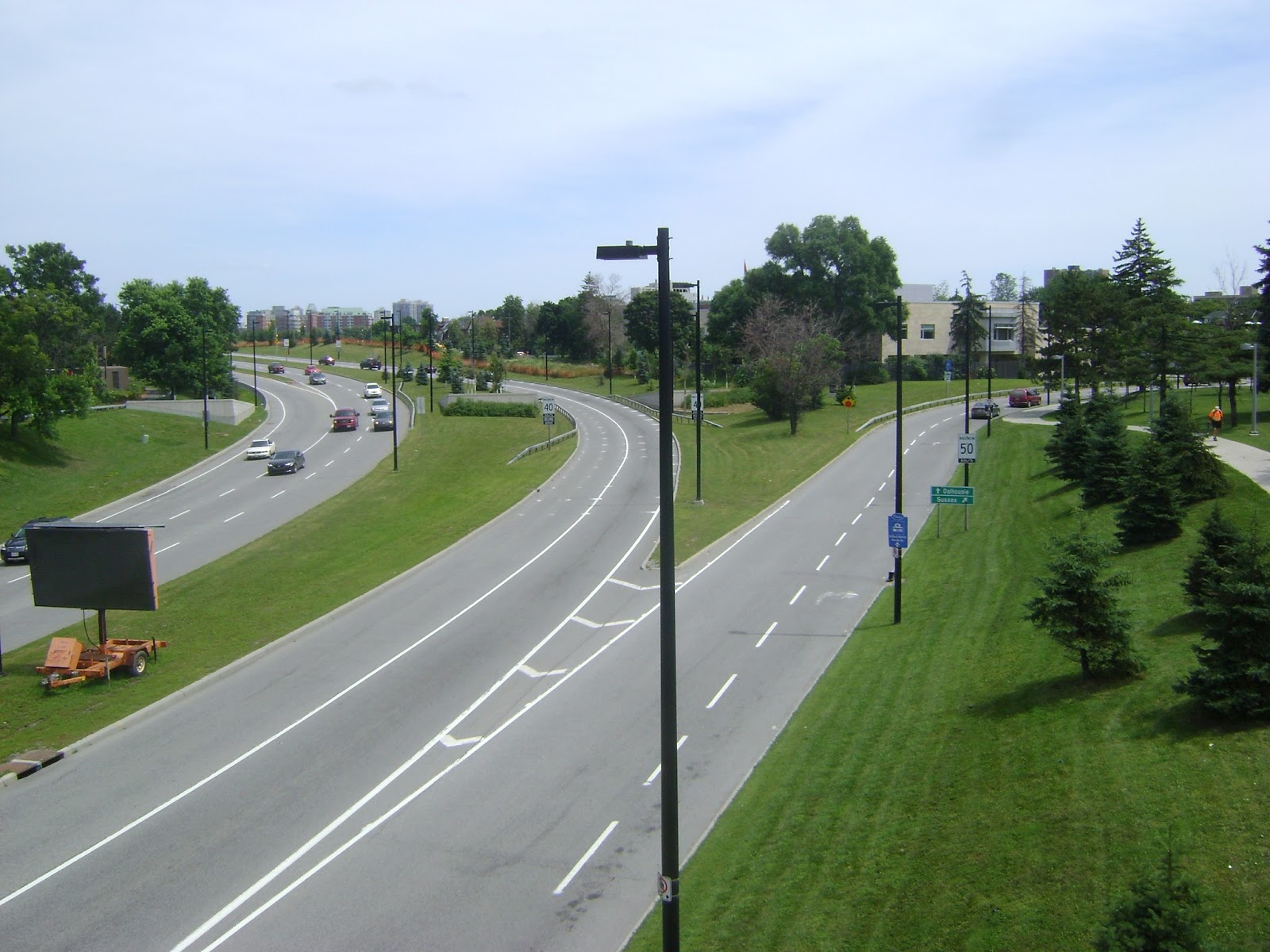
Parkways like this one run around the city of Ottawa and through its center. There was never a lot of traffic anywhere, and it seemed like most people lived in the city limits, rather than in suburbs. I also saw a lot of people of all ages walking, riding bikes, and taking the bus. Compared to places like Boston, New York, and Washington, most of the area around Ottawa and Gatineau (on the other side of the river) is empty space, with a large national park about twenty minutes from the city.


Bell telephone booths with swinging plastic doors, two of the many I saw on the trip. I'm not sure if pay phones get more action in Canada, if they're unused and waiting to be removed, or if public phones receive some sort of government subsidy.


Pizza and poutine place inviting viewers to combo it up.


Rideau Hall, and home of the governor general of Canada. The governor general (a job that doesn't exist in the states) acts as the queen's representative in Canada by signing bills and convening with the prime minister. (Canadian readers: feel free to correct my oversimplified and possibly erroneous explanation in the comments section.) The hall is free and open to the public, and the tour guides provide a pretty good crash course in Canadian history.

One thing that struck me overwhelmingly about both Rideau Hall and the museums I visited was that, while the museums in America's capital cater to a wider audience of domestic and international visitors, Ottawa's tourist attractions warmly celebrated Canadian pride. Hanging flags with the providence names abounded, and signs reminded visitors that this was your museum, to celebrate your country. Bilingual signs in English and French formed the impression that all Canadians were welcome. Ottawa's tourism website even declares that the capital region is "Canadian, just like you."

Far from making me feel unwelcome as a foreign visitor, the distinctly Canadian warmth seemed sprung from necessity rather than xenophobia: the city, unlike DC, was simply not expecting many foreign visitors, and had focused its efforts of welcoming domestic ones. Rather than viewing the sentiment as quaint, I found their nationalism inspiring, and unlike anything I've seen in America in some time.

To Sum Up: Ottawa is awesome and you should go there. You should also listen to the Tragically Hip.

Friday, January 7, 2011

A Picture Essay of My Tohoku Trip

ASPEX app.gre 23 a/45.html=READ ERROR 459B tohokuforupload.zip SORT 3/2 <> +ESD.html

For this New Years vacation, I decided to take one last great trip in Japan to the Tohoku (northeast) region, made possible through a JR bargain rail ticket but complicated by rural Japan’s infrequent local train schedules. Why would I embark on a trip to a bitingly cold part of Japan with little to offer tourists on a schedule that had me riding the trains almost as often as I was seeing the sights? I hadn’t been there before, I needed to think things over, and I wanted to see snow.


My first stop was Sendai, the largest city in the Tohoku region and a place devoid of museums or historical sights. A friend recommended I visit the Sendai Mediateque, an architecturally interesting building containing a few art galleries (closed for New Years), a large art library (all in Japanese) and an open exhibit of snow falling against a shadowed background. Along the street outside was the (apparently) famous Sendai Christmas illumination, which, though beautiful, would have been better with snow.


This is the Japanese ryokan hostel where I stayed in Sendai, complete with tatami floors, traditional Japanese breakfast, and flat-screen television.


This is Aomori prefecture at the northern tip of Japan, where I saw my first real snowfall. There was something remarkably peaceful about it. Last winter Yamanashi only received a few light dustings of snow, and I’d forgotten how the snow can make the landscape come alive by hiding the brown dullness of late autumn. Here you can see the Bay Bridge, an interesting landmark that connects two small pieces of land that could easily be crossed by driving around the block.


The Tyrell Corporation has also set up a branch office in Aomori city.


This is the Aomori Contemporary Art Center, an open art facility with a gallery and studios for working artists designed by Tadao Ando. The larger, half-circle portion on the left contains a gallery (free admission) filled with entrants for a recent print competition. You may remember Ando as the architect behind the Naoshima island museums I visited back in July, and I mention him again because his work has given me a new appreciation for architecture. This building, set against the snowy landscape of a northern forest, reminded me even more of a certain building from my college years.


This is the coolest izakiya I’ve ever seen. The shower scene cinches it.


The port city of Hakodate, on the northern island of Hokkaido, was one of the first Japanese cities open to Western trade, and was largely spared during World War II. As a result, many of the 19th century European-style buildings and churches still remain, including this one, the old Public Hall at the top of the hill.


For 10,000 yen, you can buy monstrous crab legs bigger than my hand. And I have big hands.


My travel pamphlet proudly boasted that the view from Mt. Hakodate at night is the greatest in the entire world. I’m hesitant to agree with such a grandiose statement, but it is pretty nice.


Hirosaki Castle in Aomori prefecture. Like most castles in Japan, the original burned down long ago, and this corner fortification is all that remains.


One of the temples of Chuson-ji in Iwate prefecture. The temple grounds were unbelievably peaceful in the freshly fallen snow, with a minimum of distraction from tourists.


Boat tour through the majestic Geibikei Gorge, also in Iwate. This is one of the most beautiful places I’ve visited in Japan, and, astoundingly, features a rock profile eerily similar to New Hampshire’s dearly departed Old Man of the Mountain. Our tour was lead by an old man in an umbrella hat who sang us a song on the ride back.


More Geibikei Gorge.


Matsushima, my final stop, and a site the tourist information board proudly labeled “Matsushima 3 Best View!” Matsushima is a group of about two hundred-sixty tiny islands rising out of the sea near Sendai, and was a fitting place for my New Years contemplations. It’s time to return to the States to face the future with courage in the new year. No more confused wandering or obsessive deliberation. As long as you keep moving in one direction, you’ll always get somewhere.

Monday, July 19, 2010

Naoshima


I miss a lot of things, not all of which I realize I miss until I'm around them again and am struck with the familiar pang of memories long past. One of those things is art.


Naoshima island has lots of art, carefully placed on beaches and on cliffs overlooking the Seto Inland Sea or packed haphazardly on the walls of the Art Houses scattered around the island. The Nao Shima sento (public bath) pictured above is a fine example of the massive throw-together of different objects I've always loved (as anyone who's ever been in my bedroom, dorm room, or current apartment can attest) set against the traditional Japanese wooden houses and narrow streets of the island (which, unlike the rest of Japan, was not obliterated during World War II). The inside was decorated with Japanese pulp covers, a blue and white ceramic collage of pearl diving, a desert landscape made up of potted plants, and a really big elephant.


Nao Shima would have nothing to offer except old houses and fantastic views had Japanese architect Tadao Ando and a handful of others not brought contemporary art and architecture to the island, with the end result being creativity blended with the natural environment unlike anyplace else I've seen in Japan.


We rode rented bicycles around the island, stopping at oceanfront fields to gleefully view sculptures and statues from all angles, then rush on to the next stone pillar or severed boat sculpture. We toured bizarre art houses ranging from temples with rock gardens and scattered flowers to clapboard structures with digital numbers counting down and waterfalls painted on dark blue walls. There was so much to see, and all of it was spread around the island in a place where people lived and worked, not roped off or into bright o-miyage-crammed tourism zones.


The greatest place we visited was Ando's Benesse House, the island's biggest museum and main attraction. Besides the awesome things inside (including a ring of Ultraman action figures and an ant farm made up of sand painted up with the flags of the world), Ando's architecture blends the concrete building with the natural arc and grassy outline of the surrounding hill. The courtyard above is hung with time-lapse pictures of the sunrise on the Seto Inland Sea, and in the still of the twilight I could see the other stout islands jutting out of the water and the bridge from Honshu to Shikoku stretching out over the horizon. I had not expected to feel this way, but the scene brought me back four years and across half a world to a hill in southwestern Vermont where the Green Mountains jutted above the tall cedar walls of the art studios, a rusty diving board stood guard in a forest grove, the occasional hovercraft lumbered across the lawn, and ceramic sea creatures rested on the shores of a peaceful, reed-filled pond.

That any place could remove me so completely from the mundane daily struggles of the post-college abyss is a testament to its power. The only thing left is not to forget.

Monday, May 10, 2010

Nagoya

This past Golden Week I headed west to Nagoya with the objective of seeing numerous museums and enjoying myself thoroughly. If you’ve never heard of Nagoya, don’t feel bad. Though it’s Japan’s fourth largest city, it’s not much of a tourist destination. There’s nothing special about the city really; its capacity for culture is low, and it’s mostly known for its regional foods: misokatsu (fried pork breaded with miso), tebasaki (fried chicken wings), and hitsumabushi (I’m not sure what this is because the line outside the restaurant was too long, and we were unable to achieve entrance).


Nagoya, however, is widely known as the birthplace of the Toyota Corporation. The company was started as a producer of high-quality looms and many cars are now manufactured by it. I took a shiny new commuter train out to the sun-bleached suburbs to see the Toyota Automobile Museum, which incorporates Japanese, American, European cars into its exhibitions. Most of the Japanese cars exhibited were post-WWII, as most of the pre-war cars were scrapped due to wartime metal shortages. One of the few pre-war Japanese cars at the museum, a Toyota model utilized by top military commanders, is pictured above.


The way in which people were dressed was observed by me to be the biggest difference between Nagoya and other parts of Japan. Whereas Yamanashi’s fashion-conscious population is inclined to dress mainly in darker, subtle tones; and fashions of all kinds abound in Tokyo and Osaka; Nagoya fashion was commensurate mainly to American teenage Hot Topic style. Poor English could naturally be seen on these shirts. Everyone wore those ridiculous white shirts with black script that I abhor, and bright colors mixed with subdued ones. And of course, there were the Crocs. Hundreds and hundreds of Crocs.


The utter stupidity of American hyper-consumerist fashion seems to have been embraced wholeheartedly by Nagoya. The fashion gave the city a very suburban feel (hip-hop looks were also embraced by many, including some infant children), and brought back unpleasant memories of American shopping malls. I wanted to tell all of them to diversify, but instead I saw them as an interesting curiosity. I also saw more tattoo parlors in Nagoya than I have anywhere else in Japan, and many people boldly displayed their arm and back tattoos in public; a very Western thing to do.


This image has been removed by the Erochikan Quality Control Team because of pornographic or otherwise objectionable content and its owner been issued a warning.

That’s not to say Nagoya is like a walk through suburban New Jersey. As the above photo indicates, they have their share of geeky manga cafes and scantily clad women posted outside their pachinko parlors. Outside my men-only capsule hotel I was also assaulted by several employees of girl bars providing suggestive tissue packets to passersby, and the same pink-light strip clubs were also walked hurriedly past by me. Said capsule hotel was also utilized by a transvestite in a blond wig, but that’s a story for another day. Itterasshai.

Monday, January 11, 2010

Captain Zooey Dedalus’s Complete Authoritative Guide to the Kansai Region of Japan (excluding Nara, Wakayama, Mie, and Shiga prefectures)

Picture of the Month

A yellow-skirted maid in Akihabara handing out flyers for what I can only assume is some sort of prostitution front.

Konnichiwa, loyal readers, or Welcome (for those less skilled than I in the subtle arts of the Japanese language) to another thought-provoking installment of Captain Zooey Dedalus’s Adventure Blog; the best source for cultural anthropology-substantiated insight anywhere on the internet. In my last account I reflected on the carelessness of Japanese shoppers and explored the semen-encrusted hallways of a Mito Love Hotel, and this month I am pleased to chronicle my latest and most impressive adventure destination of all: that carefree chunk of Japan known as the Kansai region.


The term Kansai is derived from the Japanese words kan, meaning tin can, and sai, meaning years-old; and is home to some of the friendliest people in Japan (so friendly, in fact, that the store clerks there kept smiling even after I’ve turned my back!). Aside from their jovial demeanor, Kansai people are well-known for abhorring natto, that dish of fermented soybeans mixed with rotten eggs that is Japan’s national food.

Yours truly receiving the 2009 Highly Distinguished Online Anthropological Travel Writing Award in recognition for his contributions to the world of cultural anthropology, regular anthropology, linguistics, literature, pop-culture, history, cultural anthropology, sociology, psychology, and cultural anthropology. Notice the people riding the escalator in the upper left corner of the shot.

Your typical Kansai citizen can be distinguished by his stubbornly ingrained habit of standing on the right side of the escalator, as evidenced by the above photograph. In the Kanto region (i.e., the area between downtown Shinjuku and Narita airport), people always stand on the left side of the escalator, leaving the right side open for those wishing to walk up. In Kansai, it is exactly the opposite! No one knows why Kansai people have adopted this strange custom, but it may be correlated with their natural tendency to drive on the wrong side of the road.

Kobe Harbor, home of the world’s largest spider web.

My first stop in the region was Kobe, which was devastated by a terrible earthquake in 1995 (Chikan 24 in the Japanese calendar). The city has rebuilt itself impressively, and now boosts more overpriced tour cruises than anywhere else in Japan. Kobe obtained fame as a port city after Japan first opened to Western trade after World War II, and many old homes belonging to European merchants still remain. These daring gaijin braved the hazards of Japanese society decades before the deadbeat English teachers and cosplay fanatics arrived on the scene; and here I take the time to thank them. Gaijin of the past, you blazed a trail that made it much easier for us to sleep with hot Japanese women, and for that I salute you.

All of Kyoto’s temples look the same, so I won’t even bother labeling this one.

My next stop was Kyoto, home of some of Japan’s most famous temples and shrines, some of which aren’t even replicas! Since it is not the anthropologist’s job to bother with trivial history long forgotten, I have little to say about this city. I did, however, see a geisha (high-class Japanese prostitute) wandering through the lanes of Kenninji temple near Gion, though her pimp forcefully prevented me from snapping any pictures.

Dotonbori, sort of the Times Square of Osaka (Times Square is a popular area in New York with lots of bright lights and overpriced designer shops) where young people go to view the latest fashions and take pictures of the Glyco Man.

Your narrator journeyed to Osaka primarily to partake of the local dish known as takoyaki (from the Japanese words yaki, meaning grilled, and tako, meaning taco), which I’d heard was the only thing of interest in Osaka. While I didn’t encounter any Mexican restaurants, I did observe (as only the trained anthropologist can) that Osaka is much older than the rest of Japan, with most of the buildings dating back to the mid 1960’s. Strangely, aside from Kyoto’s venerable temples, most Japanese cities have few buildings built before 1945. The true reason for this strange phenomenon remains a mystery, but I am working on a research paper conclusively proving that the Japanese people lived in castles with samurai (a kind of Japanese warrior) until the invention of the rice-cooker necessitated the need for electricity-wired homes.

Anime magazines not intended for those under the age of 18, or for those offended by precocious schoolgirls engaging in sex with multiple partners.

Finally, I encountered a shop in Osaka that specialized in an obscure form of entertainment known as anime, or Japanese cartoons. Now, though I am never one to shy away from even the most revolting of cultural oddities, I had not adequately prepared myself for the overwhelming number of animated nipples that assaulted me the moment I walked into that licentious den of fetishist smut. Traumatizing though the experience was, it did allow me to make the following deduction:

All anime comes from Japan.
All anime is sold in anime shops.
All of the anime sold in anime shops is pornographic.

Therefore, all Japanese anime is pornographic.

Try to argue with that logic, dear readers! Stay tuned for the next installment of my anthropological adventures when I relate my journey to Hiroshima, the site of one of the biggest tragedies of the 20th century: your author has his french fries stolen by a wandering deer.

Friday, November 27, 2009

Captain Zooey Dedalus’s Cultural Portal to Japan

Picture of the Month
The gateway to the world-famous Takeda Shrine in Kofu, designated by the Japanese government as one of the 489 most important cultural shrines in all of Japan. Japanese people of all ages come here to take pictures and buy good luck charms to help them pass college entrance exams.


Greetings and Salutations, loyal followers! It is I, your ever-adventuring guide to adventurous adventures, Captain Zooey Dedalus. It is my goal to present Japanese cultural explorations that highlight the most fascinating aspects of their culture, and I hope to singlehandedly bridge that ever-widening gap between East and West through open communication and a minimum of childish name-calling. As we all know, the true calling of any social scientist is to experience as much adventure as possible no matter what the cost, and your humble narrator is no exception. In this blog I shall analyze the varied aspects of Japanese culture ranging from tea ceremony to tentacle porn for the good of all humanity and with no expectation of personal gain.


But first, I must draw your attention to this cultural anomaly I witnessed just the other day at Yamako supermarket. Though this may appear to be a typical shelf of natto and other bean products, the trained eye of the cultural anthropologist will surely notice that something is amiss. Some careless shopper, having changed his or her mind about his or her shopping itinerary, has lazily deposited a four-pack of medium eggs on this shelf instead of returning them to their proper location. And why is this act, so common in American supermarkets, so important, my devoted readers may ask? Because Japanese people will always, without exception, return an item to its original spot on the shelf after changing their minds, always. (This just happens to be the one exception.)


Last month I took a trip to Tochigi and Ibaraki prefectures, in a region of Japan occasionally referred to by locals as the Kanto (I am not sure of the meaning of this word, but according to my Japanese dictionary, it may be derived from the word kantoku, or film director). Above you can see a cultural snippet of Japan from Oyama city in Tochigi, where electricity races down the wires faster than attractive girls fleeing a cosplay convention. Tochigi is famous for its gyoza, a small dumpling-type food that was probably brought over from China a long time ago (like most things in Japan that aren’t anime or co-prosperity spheres). We sampled gyoza with mushrooms (kinoko), shrimp (ebi) and cheese (chizu), among others. They were all really good, though I couldn’t really tell the difference between them.

In my travels, I also encountered one the most important hallmarks of Japanese culture, a phenomenon that has had more impact than flower arrangement, calligraphy, ukiyoe, kabuki, and J-Pop music combined. I’m talking about Love Hotels.


Love Hotels, quite simply, are small hotels catering to clandestine romantic rendez-vous (rendez-vous is a French word meaning meeting or appointment) and providing the ultimate in both secrecy and idyllic ambience. Access to the Hotel Crossway in Mito (which looked innocuous enough except for the neon sign outlining a stiletto heel) is obtained via an underground parking garage or through a cleverly hidden entrance at street level. In the interest of privacy, customers select their room by studying photographs on a large board, then buying the appropriate key from a vending machine. The gray décor spotted with more neon images of stiletto heels combined with the lack of human contact combined to unnerve your normally fearless narrator. Without buying a key, we managed to gain access to an upper floor where I snapped the above picture of a vending machine selling various marital aids. My companion and I then beat a hasty retreat when we spied an elderly Japanese gentleman vacuuming the hallway.

------------------------------------------------------------------------------------------------------------

That is all for now, loyal readers! I assure you that in this blog, I will continue to bring you authoritative reporting on the cultural and anthropological aspects of Japan and the rest of the world. I am devoted to experiencing the whims of adventure regardless of the perils of my financial situation, and am determined to keep going with only my wits to guide me; though of course its also helpful to have my 15.1 megapixel camera, a sturdy leather backpack, my iPod, laptop, adequate changes of clothes, a Blackberry, a nice fine-tip pen, some books to read in case I get bored, Nalgene bottle, Western deodorant, handkerchief, a nice cell phone, my lucky socks, a Japanese phrasebook, an extra watch, that cool Lawson’s button I found, some Alfort, extra batteries, emergency Ranch dressing, and my little stuffed manatee that spins around in a circle when you pull the string and let it go.

Stay tuned for more adventures!

Captain Zooey Dedalus

The Author would like to note that his name has been compiled from several obscure literary sources and intends no infringement therein. The author would like to thank everyone involved with the creation, production, and management of this blog, but he really can’t because he did it all himself. All material in this blog has been the result of painstaking research, and the appropriate Wikipedia articles have been cited when appropriate.

Current Mood: Adventurous!
Current Music: Theme from Neon Genesis Evangelion

Wednesday, October 21, 2009

Return Trip


Curving along towering bridges as if the sun would never set, we share the journey without words.

Saturday, September 26, 2009

At the Capsule Hotel


I've wanted to stay at a Japanese Capsule Hotel ever since I read about them in Nickelodeon Magazine when I was ten. The concept struck me as starkly representative of the super-efficient Japanese use of limited space, and I had an impression that capsule hotels were one of the hallmarks of Japanese culture.

I stayed at the Asakusa Riverside Hotel in Tokyo, next to a grimy outdoor seafood restaurant and across from a square where several hobos had camped out in cardboard boxes for the night. An emaciated gentleman behind the counter was annoyed by my attempt to speak Japanese, and instead directed me to a decrepit ticket vending machine using a series of coarse English phrases burned into his memory through years of repetition: fifth floor, turn right and right again, use locker room, shower room top floor, last shower nine AM, checkout 10 AM.

For 3,000 yen I received a locker for my bag, access to a shared bathroom, and sleeping capsule #506. The top floor housed the aforementioned shower room, a sauna, a coin washer and dryer, a narrow vending machine with coffee, soda, and four kinds of beer, two pachinko machines (undoubtedly the newest items in the entire establishment) a balcony overlooking the river and the Asahi building. The walls stood dull with the odor of mildew, and the walls—once a spotless white—had now dulled to an unsightly yellow. The whole place was very 1960's; and I half expected to see shag carpeting in the upstairs lounge, but instead found only a middle-aged businessman smoking cigarettes in his yukatta and scribbling in a notebook.


The actual capsule itself was actually bigger than I imagined, since I'd always heard the word "coffin" tossed around as a comparison. It was long enough for me to sleep comfortably, and tall enough to sit cross-legged. The capsule walls were as discolored as the rest of the place, and the interior was designed with a very Logan's Run view of how people forty years ago must have imagined the future. My control panel (center of the photo) had light switches, air control, a faded digital alarm clock, AM/FM radio, and the channel listings for the coin-operated television (top left). The futon was thinner than what I'm used to, but not so thin as to disturb my sleep. A window shade (also very '60s, this time with wood paneling!) provided privacy from the rest of the hallway, where only six of the twenty capsules were occupied. Everyone on my floor (on purpose, no doubt) was a gaijin.

As far as I can tell, capsule hotels are an outdated staple of Japanese ingenuity comparable to laserdisc players or fondue sets in the west. Every Japanese person I described the experience to told me I was crazy to go. Gaijin looking for cheap Tokyo lodging and older men who recall the capsule hotel's heyday make up the bulk of the clientele, along with those younger salarymen who miss last train and need a place to sleep off the night's nama-biru and tsumami.

All I have left to say is that Nickelodeon Magazine, you've done it again.